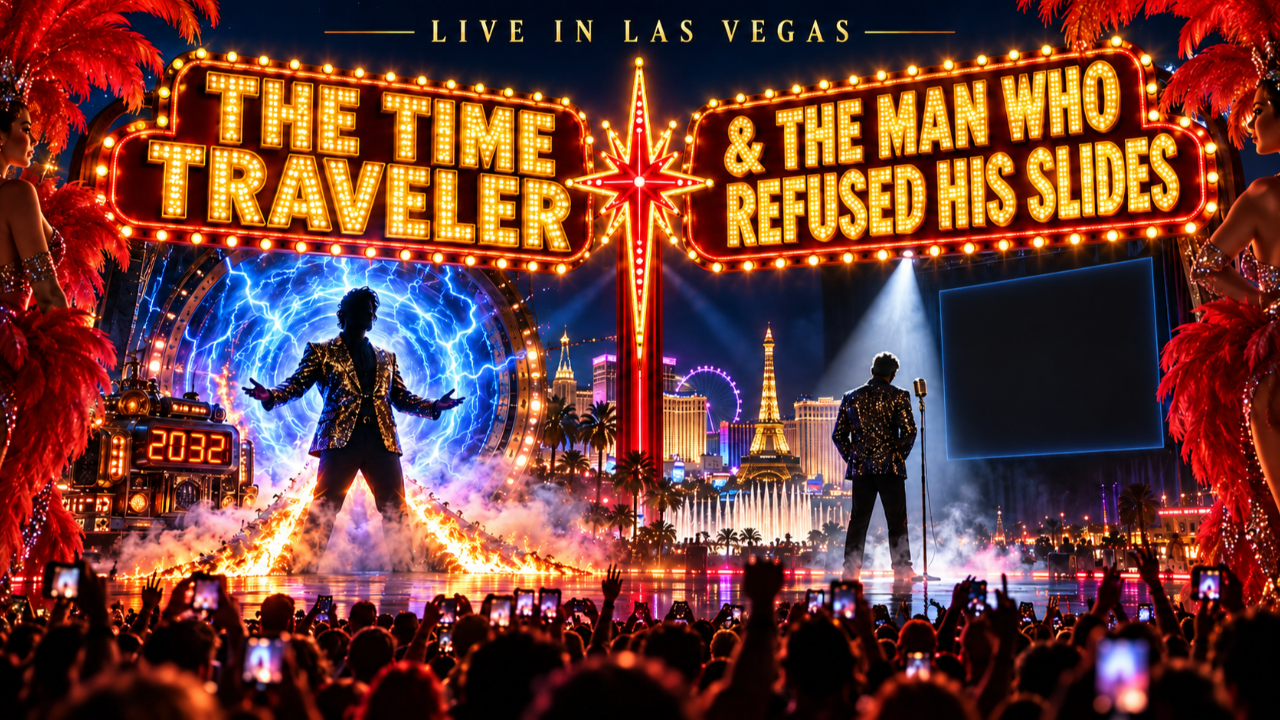
The Time Traveler and the Man Who Refused His Slides
Greetings from 36,000 feet.
I’m sitting in a chair nearly seven miles above the ground, traveling at 500 miles per hour. Something we take for granted, yet a century ago it sounded like science fiction.
That’s where our world is headed.
I’m flying home from Funnel Hacking Live 2026: The AI Era, and my notebook is full. We watched AI build offers, write content and run entire departments live on stage. Miguel Carrasco said it best: “This is a civilizational shift that is going on right now.”
The more AI can do, the more the person at the front of the room matters. While information is everywhere, human beings take action when they feel something.
I spent 20 years creating content for some of the most demanding properties in the entertainment industry, so I know what it takes to hold an audience’s attention. Professional performers have relied on the same Hollywood principles for a century. When I wrote Your Million Dollar Masterclass, I set out to share how those same performance principles can be applied to your webinars.
At FHL, two speakers put those principles on display from opposite ends of the spectrum.
Miguel Carrasco brought a full production: time-travel graphics, a live AI demo on the big screen and a QR code for everyone with a cell phone. Peter Swain brought no slides at all. Only that British humor that keeps us Americans on the edge of our seat wondering “what’s he gonna say next?”
Both men know more about AI than most attendees ever will. They could have walked out, opened a slide deck and delivered a monotone dump of everything they know. We’ve all experienced death by PowerPoint. The room would have taken notes, checked their phones and forgotten most of it by dinner.
Instead, Peter and Miguel commanded the stage and positioned themselves as the rock stars of their industry.
If you were in that room, you experienced it. But today I want to dissect what was happening underneath, so you can apply it to your own presentations, regardless of whether you come with a full tech setup or just a microphone.
They Played the Songs You Already Know
Think about the last concert you attended. The artist may be touring a brand-new album of songs you’re unfamiliar with, but it’s not long before they play something everyone knows. Sometimes it’s a cover you didn’t expect. Either way, the moment those first notes hit, the whole arena sings along. Strangers become unified, and the artist becomes someone you feel like you know.
Both Miguel and Peter quickly introduced familiarity to an audience that largely didn’t know them.
For those of us who consider ourselves children of the 80s, Miguel had us the moment his Back to the Future entrance rolled. Then he asked his AI brain, Solomon, “Besides Back to the Future, what’s my favorite movie of all time?” The answer was the 2002 film The Count of Monte Cristo.
I’ll admit that one got me personally. It’s my favorite movie as well, followed by the Back to the Future and Star Wars trilogies, with a little Karate Kid thrown in. (Side note: My wife still tells people about the first time she came over to my house to watch a movie and had to sit through The Count of Monte Cristo...)
Peter referenced the 90s. He asked the room if everybody remembered the scene from The Matrix where Morpheus offers Neo the red pill or the blue pill. Of course we did. He also told a story every parent in the room has experienced: teaching a child to walk. He shared how the child pulls up on the sofa, takes one step, falls, and the parents celebrate like it’s the greatest thing that ever happened. Every parent in the room was nodding before he made his point: “Knowledge comes from action, not the other way around.”
The specific references don’t matter much. They could have talked about Pretty in Pink, The Breakfast Club, or Ace Ventura... What matters is that each reference handed the audience something they already loved, and a little of that feeling transferred to the person on stage. Everyone familiar with those films felt like the speaker was talking directly to them. That’s how you create an instant connection with a crowd of thousands.
They Set the Temperature Before the Show Started
Picture a headliner walking on stage at Madison Square Garden: “Hello New York! Are you ready for the night of your life?” Now picture the same artist shuffling out, tapping the mic and asking, “Is this thing on?” One of those shows is over before it starts.
The first 60 seconds set the temperature for the entire show. Make sure yours is a rock-star entrance.
Miguel’s entrance began before he set foot on stage. A video played of Russell calling him: “Miguel, it’s Russell. I need you back in 2026.” A destination locked, and Miguel arrived from the future. Within a minute, the room knew the theme and it was clear we were in for something fun.
Peter took a less technical route, but rock-star nonetheless. He pledged a personal donation to help get children out of trafficking, scaled to the energy of the room. A sucky audience would earn $1 per person, an okay one $2, and an amazing one $3 per person. Then he asked how good an audience we wanted to be.
That game made Peter the thermostat. A thermometer reads the temperature of the room, while a thermostat sets it. The headliner at the Garden decides what the night will feel like, and Peter decided, inspiring 1,800 people to raise their energy to his standard, before he taught a thing.
They Took Us to the Future First
Future pacing is one of the most powerful tools a speaker has. It should be automatically built into every presentation you give, whether virtual or live. People buy based on emotion and justify it later through logic. Nothing creates emotion like letting someone experience their own future.
Miguel future-paced the room within his first few minutes on stage. He told us he’d stopped in 2032 on the way here and met two people who were in this room right now.
Person A said “yes” at FHL and went all in on AI. In 2032, Miguel found them on a beach in Turks and Caicos, talking with their family and their kids, doing human things instead of staring at a phone.
Person B was “too good for school.” They thought they knew it all, and in 2032 their business was dead. They were blaming AI for its demise. Miguel even asked how many of us had ever felt like we knew more than the presenter on stage, and admitted he was guilty of this himself. Talk about making a connection with your audience...
Then he quoted Tony Robbins: “It is in your moments of decision that your destiny is shaped.”
Every person in that room decided which option, Person A or Person B, they were going to be. The stakes became personal before he taught a single thing, and unbeknownst to us at the time, Miguel opened a loop he wouldn’t close until the very end.
They Built a Setlist
A great concert is never one long song. The set moves from the big opener to the song everyone dances to, down to the quiet moment and back up again. Every shift pulls the crowd back in.
A great presentation needs the same thing. Coming from a few decades as a performer, and creator whose work has appeared in over 200 tv series, I’ve learned that roughly every three minutes there must be some form of state change.
Map Miguel’s talk and you’ll find a new segment every two or three minutes. “Say yes.” “A show of hands.” “Close your eyes.” He even posted a QR code that put a live AI clone of Miguel in 2,000 phones, turning spectators into participants in real time. And after twenty minutes of AI-focused content, a massive pattern interrupt: “I want you to forget AI for a minute.”
His visual demo was its own kind of state change. He’d say, “I hope the Internet’s good, ’cause is it okay if I do everything live?” Nobody buys a ticket to watch a band lip-sync. We go for the experience of the live show, and with every live show there’s a chance that something could go wrong. Miguel owned that possibility with a sense of humor: “If the whole thing crashes, it’s the Wi-Fi.”
Peter had a harder job. With no slides, every state change had to come from Peter himself. Production asked if he was sure he didn’t want any and his answer was, “You can put them up if you want. I’m just gonna ignore them.” So he worked the room the way an artist works the crowd between songs. A question to the audience. A joke. The moment attention could drift, he had the ability to pull it back. Being on stage is his happy place.
Miguel, on the other hand, called himself “a super introvert.” You’d never have known it. Commanding a room is a skill, and anyone willing to learn it, can.
They Asked Permission
When an artist comes back for the encore, they ask the crowd, “Who wants to hear some more music?” The crowd screams yes, and now they’re bought in.
Both speakers used this technique constantly. Miguel asked, “Is it okay if I do everything live?” before the demo, and from that moment every person in the room was invested in the demo working. Before his closing exercise, he asked again: “Can I do something cool right now with you guys?”
Peter asked for permission right out of the gate. He laid out the charity game and checked with the room before committing a dollar: "Is that cool?" Only after the room said yes did he ask how good an audience we wanted to be.
His magic prompt for AI was his own encore moment. "Who wants the magic prompt?" Then, "You ready?" Then again, "You ready?" By the second yes, you could hear 1,800 attendees from a few blocks away. The room asked for it before he shared it, so every person was ready to receive it.
In between, he kept collecting smaller yeses. "Everybody remember that scene from Matrix?" "Everyone agree?" With no slides to lean on, each question pulled the room back in and earned him permission to take us to the next idea.
Each yes is small. Stack enough of them and the audience has agreed its way through your presentation. People who feel invited, lower their guard. But those who feel lectured to, raise it.
They Saved the Acoustic Moment for the End
Every great concert has the moment when the lights dim, the artist steps forward alone, and thousands of people go quiet at once. It’s that one powerful moment everyone experiences together, and becomes the topic of talk on the drive home.
Miguel’s acoustic moment closed the loop he opened in his first few minutes. He brought the whole room to its feet, eyes closed, music playing. We visualized it being 2032, the same year he’d visited at the start. Russell calls and invites you to Madison Square Garden. Your family is in the front row, 50,000 people are in attendance, and you walk onto that stage.
At the start, Miguel told us about Person A. At the end, he made every person in that room visualize being Person A. That’s the identity shift. The audience experienced who they were becoming, and the whole talk came full circle.
As a professional musician for a few decades, Madison Square Garden is the standard I held myself to, so you can imagine how that moment landed for me.
Peter’s acoustic moment was his son Sam, who was struggling to learn to read. To help him, Peter used AI to write him a custom book at his reading level, Sam the Space Pirate. He shared that moment Sam looked up and said, “Dad, you wrote me a book.” He read it cover to cover, again and again.
Then Peter brought it right back to the topic of his talk. That book is the epitome of why he wants us to use AI: so it can take everything else off our plates and leave us more room for moments like that one. Peter had opened with his grandfather’s regret about missing the moon landing, and he closed with a moment he’ll never regret. Then he landed on identity: “We walked away from being a human being, and into being a human doing.”
That story hit me in a powerful way. I’ve already told my wife what we’re doing for Christmas this year. Our son, Mason, is going to make up a story, and I’m going to use AI to help write and illustrate it into a real book that we will give him on Christmas morning.
Moments like that stay with you, the way a great performance does. I still remember Woodstock 1994 and Aerosmith playing “Toys in the Attic.” For one, it was Woodstock, and for a kid raised in Woodstock, walking down the street and jumping the fence to experience something historic with over 100,000 other people is something you never forget. (Plus, I had Toys on vinyl, and it’s an incredible album!)
Some moments never leave your memory, and as a father, Peter’s story about Sam’s book is permanently etched in mine.
One speaker took the room into the future. The other took it into his home. Both landed on who we are, and a close that lands on who we are is the one we carry with us.
The Rock Star of Their Industry
Put these two talks side by side and you’d think they came from different conferences. One was a full production. The other was one man and a microphone. Underneath, they ran the same playbook every great performer runs, and both walked off that stage positioned as rock stars of their industry.
If your stage is virtual, these principles matter even more. Your audience is watching from the most distracting environment on the planet: their home. The bills that need to be paid are on the desk, and Netflix is one click away. The expert who plays the songs that resonate, sets the temperature, takes them to the future first, builds a setlist that creates an engaging experience, asks permission and saves the acoustic moment for the end is the one who keeps them in the room all the way to the offer.
Performance is the mechanism. Conversion is the outcome.
Peter ended with a simple, yet powerful line: “You don’t need knowledge. You need to take action.”
We’ve started our descent. In a few minutes I’ll be on the ground, heading home to do exactly that.
Thank you, Miguel. Thank you, Peter. You set the bar for every speaker in that building.
Have you ever dreamed of creating a highly profitable business that gives you the freedom to design your lifestyle so you can do the things you love?
In this free ebook, you're going to learn how to build a 7 figure online business that dramatically transforms your life, and allows you to earn passive income while you sleep!
Download the FREE E-book now!
7 Simple Steps to a 7 Figure Business!